Multipoint Thermocouple Applications and Design Selection
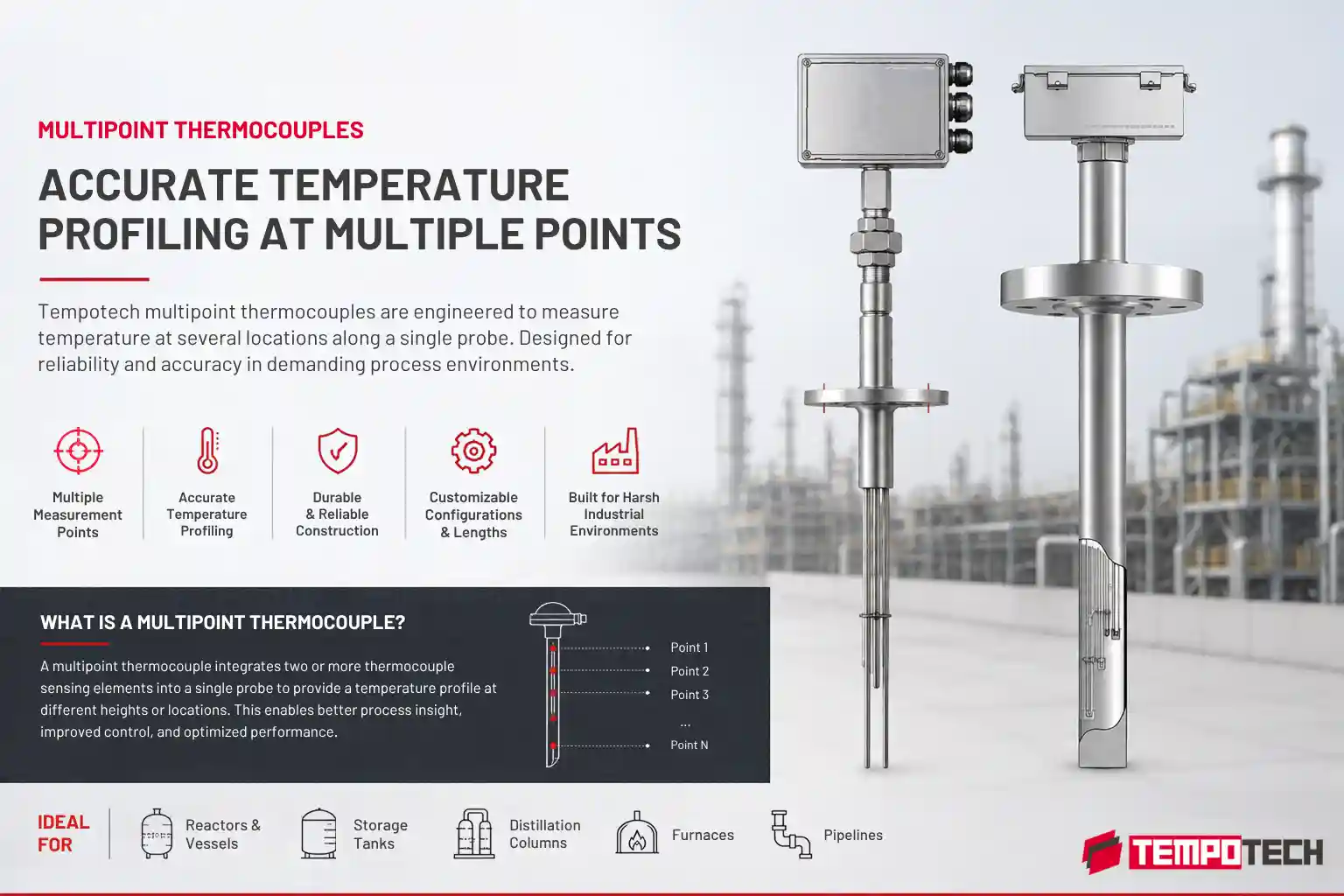
Multipoint thermocouples provide temperature measurements at multiple points within reactors, vessels, tanks, columns, and other industrial process equipment
A multipoint thermocouple captures temperature readings at several discrete points along a single probe, rather than relying on a single sensing location. This distinction is critical in large or thermally uneven processes, where a single reading may obscure the presence of localized hot zones within the vessel. While a single-point thermocouple provides only one data snapshot, a multipoint design delivers a comprehensive thermal profile through a single installation.
This capability is achieved through an isolated, or ungrounded, junction design. Multiple measuring points are positioned at intervals along the probe, each independently wired to generate individual readings. This configuration enables a single sensor assembly to replace multiple separate thermocouples that would otherwise be mounted at various depths or heights, thereby reducing the number of penetration points into reactor walls or column shells.
This architectural approach explains why industrial facilities often specify multipoint temperature sensors instead of multiple single-point units: they require fewer process penetrations, simplify wiring, and provide a consistent thermal profile from a single device
How does a multipoint thermocouple differ from a standard thermocouple?
A standard thermocouple measures temperature at a single, fixed depth. In contrast, a multipoint thermocouple reports multiple temperatures simultaneously along its length, revealing gradients, hotspots, or uneven flow patterns that a single sensor cannot detect.
How Does a Multipoint Temperature Sensor Work?
A multipoint thermocouple utilizes a single mineral-insulated sheath that houses several measuring junctions along its length, each independently wired to capture temperature at a specific point rather than providing an one point reading. This configuration enables the multipoint sensor to function as several thermocouples within a single probe, rather than as a single-point device.
Why Does Junction Placement Matter for Accuracy?
The placement of measuring junctions determines whether a probe accurately captures process variation or inadvertently masks it. Uneven spacing or clustering junctions near known hotspots yields a more informative temperature profile than uniform spacing. In temperature profiling thermocouple installations, engineers strategically position junctions to correspond with expected thermal zones within a reactor or column, rather than simply placing them at physical midpoints.
Can Multipoint Probes Be Customized for Specific Processes?
Customizing junction counts, spacing, and sheath materials enables probes to match specific vessel geometries and thermal profiles. TempoTech Controls Inc leverages extensive engineering expertise and manufacturing capabilities to support these complex configurations for demanding process conditions. With over three decades of industry experience, TempoTech Controls delivers reliable and innovative temperature measurement solutions tailored to each application’s actual thermal behavior, rather than relying on generic probe designs.
Where Are Multipoint Thermocouple Applications Used?
Chemical reactors, catalytic crackers, fractionation towers, and fluidized bed catalyst tanks utilize multipoint thermocouples to monitor temperature behavior across a single process vessel. Petrochemical plants depend on these measurements to detect uneven heating before it damages equipment or compromises product quality. A single sensor with multiple measuring junctions can replace several separate probes, thereby simplifying wiring and reducing potential points of failure within crowded process units.
Why Do Reactors Need Multipoint Temperature Sensing?
A reactor multipoint thermocouple captures temperature gradients that a single-point probe cannot detect. Reaction zones often heat unevenly, with hotspots forming away from standard sensor locations. Engineers utilize profiling data from these arrays to adjust feed rates, catalyst loading, and cooling, thereby preventing localized overheating that could damage catalyst beds or reduce conversion efficiency.
How Does Multipoint Sensing Help Distillation Columns?
The placement of measuring junctions determines whether a probe accurately captures process variation or inadvertently masks it. Uneven spacing or clustering junctions near known hotspots yields a more informative temperature profile than uniform spacing. In temperature profiling thermocouple installations, engineers strategically position junctions to correspond with expected thermal zones within a reactor or column, rather than simply placing them at physical midpoints.
Oil and gas — process temperature tracking across extraction and refining equipment
LNG — instrumentation suited to cryogenic and high-throughput operations
Heat treatment — accurate profiling across furnace zones
Food and pharma — sensors supporting controlled, compliant processing
Mining — instrumentation built for demanding industrial conditions
Across these industries, advanced instrumentation is designed to deliver precision, reliability, and efficiency in daily operations. Tailored sensor designs enhance performance, optimize process control, and support safety and regulatory compliance in diverse industrial environments, providing plant managers with a more comprehensive temperature profile than single-point measurement can offer.
Inside a multipoint thermocouple, multiple sensing points are positioned at different locations to measure temperature profiles throughout the process
When does a reactor need multipoint temperature monitoring?
Reactors that handle exothermic reactions, catalyst beds, or variable feedstock compositions benefit most from distributed sensing. Uneven flow through packed beds or agitation dead zones can create localized hotspots that single-point detection may miss. Engineers evaluating these approaches often consider the following factors:
Factor
Single-point sensor
Multipoint sensor
Temperature gradient risk
Low, negligible gradients
High, complex or large vessels
Hotspot detection
Limited
Multiple junctions along probe length
Process complexity
Simple, uniform reactions
Large-scale or variable reactions
TempoTech is recognized in the instrumentation field for engineering custom-built solutions tailored to demanding multipoint temperature measurement applications, including reactor profiling. The company’s approach focuses on precise, reliable sensor construction matched to each client’s specific reactor geometry and process conditions. This engineering discipline demonstrates a broader commitment to reliability, consistent performance, and long-term customer satisfaction in chemical processing and refining environments, where accurate reactor data directly impacts product quality and operational safety.
How Is Distillation Column Temperature Measurement Achieved?
Engineers achieve distillation column temperature measurement by installing sensor arrays that span the full height of the vessel rather than relying on a single probe. Column internals such as trays create distinct temperature zones, and capturing that variation requires multiple measurement points working together along one continuous profile.
A tray-based distillation column shares structural similarities with an amine contactor, which typically stacks 20 to 22 trays at equal distances apart. Each tray represents a separate stage where vapour and liquid streams interact. Process gas entering the column at a lower temperature contacts a slightly warmer liquid phase on every tray, producing measurable temperature variation from one stage to the next. Because the reaction between the two streams is exothermic, the gas temperature climbs as it moves upward through the column.
Why Does a Single Thermocouple Fall Short in a Column?
A single sensor captures data from only one location, typically positioned near the bottom of the vessel. While this provides some insight, it cannot reveal how temperature and reaction progress shift across the remaining trays. Without a comprehensive sensor array, plant personnel may struggle to identify where the majority of the process reaction is occurring.
What Role Does a Multipoint Sensor Play in Column Monitoring?
A multipoint thermocouple addresses this limitation by incorporating several sensing junctions along a single probe assembly. Instead of installing separate instruments at each nozzle, engineers deploy a single temperature profiling thermocouple that provides a continuous vertical profile. This approach makes comprehensive multipoint temperature measurement operationally feasible.
Benefits of a column-spanning multipoint temperature sensor include:
Identification of the tray or zone where the reaction concentrates most heat release
Early detection of flooding, channeling, or uneven vapour distribution
Reduced instrumentation footprint compared to multiple single-point probes
Better data for tuning reflux ratios and feed conditions
Engineered custom sensor solutions are essential for demanding column and tower applications. Instrumentation providers prioritize reliability and precision in these measurement challenges, favoring tailored designs over generic, off-the-shelf options.
Miniature Multipoint Thermocouple with Lead Wire
The MPTC-01 uses a miniature multipoint design with individual lead wires to provide temperature measurements at multiple selected locations while keeping the overall sensing arrangement compact and flexible. This design is beneficial where installation space is limited or where sensing points need to be routed to specific locations within equipment. Its flexible construction makes it suitable for thermal profiling, test equipment, compact process systems, and applications where installing a larger rigid multipoint assembly would be difficult.
Guide Tube with Heat Sink Contact Sensors
The MPTC-02 combines multiple heat-sink contact sensors with a guide-tube arrangement. The guide tube supports and positions the sensing elements, while the heat-sink contact design promotes thermal contact at each selected measurement location. This configuration is particularly useful in reactors, vessels, columns, and similar process equipment where engineers need temperature readings from defined positions along the process. The design helps maintain consistent sensing locations while providing a temperature profile across multiple process zones.
Free-Hanging Multipoint Thermocouple
The MPTC-03 uses a free-hanging design that allows multiple thermocouple sensing points to be positioned along an extended measurement length without relying on one long, rigid probe assembly. This flexibility is beneficial in tall reactors, towers, columns, and large vessels where installation access, vessel length, or internal geometry can make rigid assemblies difficult to install. Multiple sensing points can monitor temperature changes at different elevations, helping operators identify temperature gradients and localized hot or cold zones throughout the process.
Multipoint Guide Tube Style Thermocouple
The MPTC-04 uses a guide-tube design to support and organize multiple thermocouple sensing points along the required measurement length. The guide tube provides mechanical support and helps maintain the intended position of the sensing elements after installation. This is beneficial in reactors, distillation columns, fractionation towers, catalyst beds, and other process vessels where temperature must be monitored at repeatable locations. By keeping multiple sensing points positioned along the process, the design provides a more representative temperature profile while reducing the need for multiple separate sensor penetrations.
How Do You Select a Multipoint Thermocouple System?
The selection process begins with engineering discipline rather than simply choosing from a catalogue. An effective multipoint thermocouple program starts with clearly defined objectives, focusing on engineered custom solutions that deliver high-quality, reliable performance at a competitive cost. Sensor length, junction count, and sheath material are determined by process conditions, rather than being selected arbitrarily.
The reliability of the underlying sensor technology is fundamental to any credible selection process, especially at measurement points where a failed junction creates a blind spot in a reactor or column. Engineers evaluating multipoint temperature sensors should consider insulation resistance, junction isolation, and sheath durability under thermal cycling before comparing costs. A sensor that drifts or fails prematurely incurs greater losses in production data than any initial savings on procurement.
What Factors Matter Most in Multipoint Sensor Selection?
Several technical variables determine whether a design will perform reliably over years of service, rather than only for a short duration.
Number and spacing of measuring junctions relative to the process zone being profiled
Sheath material and diameter, balanced against mechanical rigidity and insertion length
Signal integrity across long lengths, especially in electrically noisy plant environments
Does the Selection Process End at Installation?
No. Sensor selection and design should be viewed as an ongoing process of continuous improvement rather than a one-time transaction. As process conditions and production rates change, instrumentation requirements must evolve accordingly.
Therefore, ongoing evaluation is as important as the initial specification. Facilities that periodically review sensor performance can detect degradation early, before it impacts yield or safety margins. Treating instrumentation selection as a continuous engineering partnership, rather than a one-time purchase, ensures measurement accuracy remains aligned with actual plant conditions over time.
Conclusion
In conclusion, selecting the optimal multipoint thermocouple configuration requires a rigorous assessment of process environment, temperature gradients, and measurement precision requirements. TempoTech Controls Inc engineers custom thermocouple solutions that address these critical variables, delivering the accuracy and reliability required for industrial operations. The company’s commitment to tailored design ensures that temperature monitoring systems perform effectively across aluminium foundries, chemical plants, steel mills, and other sectors, supporting production efficiency and process control objectives.
Key Takeaways
Multiple measuring points provide temperature readings at several defined locations within a single assembly, creating a clearer temperature profile than a single-point sensor.
Better hotspot detection helps identify temperature gradients, localized hot or cold zones, and uneven process conditions in reactors, columns, and vessels.
Application-specific designs include miniature lead-wire, heat-sink contact, free-hanging, and guide-tube configurations to suit different process and installation requirements.
Fewer process penetrations allow multiple temperature points to be monitored through a single multipoint assembly, reducing the need for several separate sensor installations.