

Top Mistakes Choosing Thermocouple Practical Guide Temperature Accuracy Sensor Life
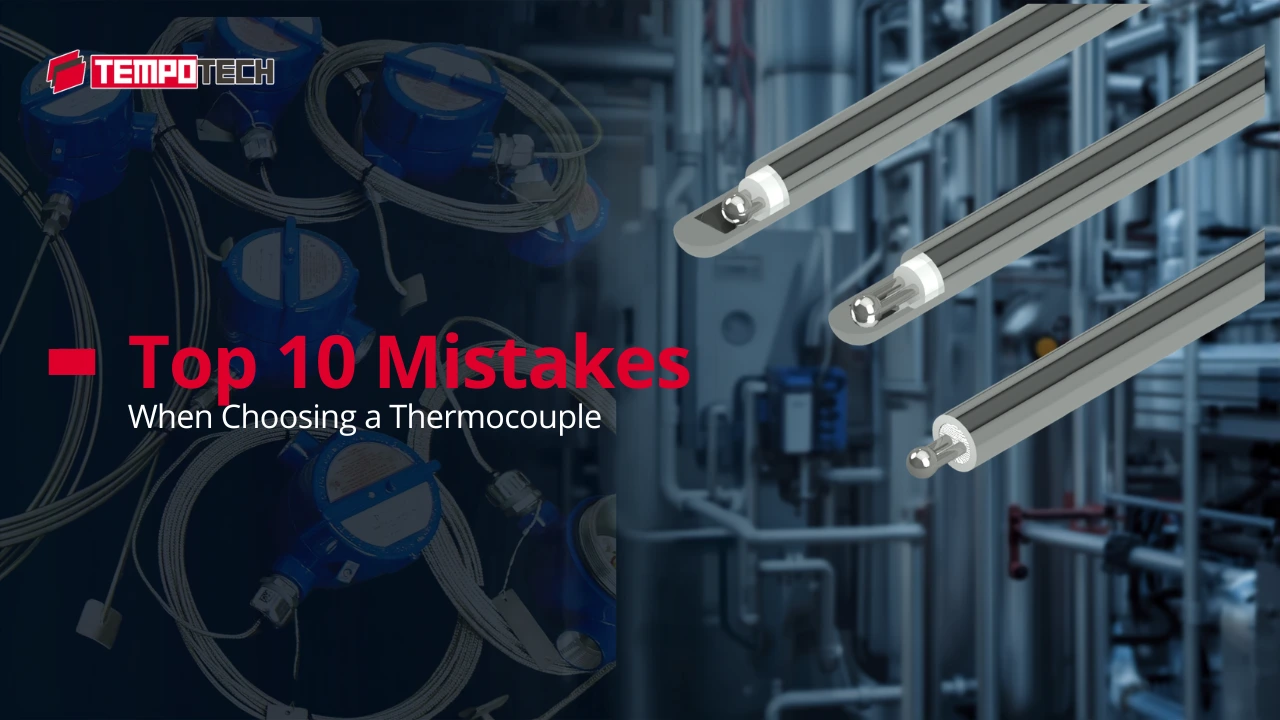
Common thermocouple selection mistakes include ignoring sheath material compatibility, mismatching junction type to process speed, overlooking insertion depth, and skipping recalibration schedules. TempoTech Controls Inc, which engineers custom sensor assemblies, notes that correct assembly selection and proper installation directly determine measurement correctness, process efficiency, and long-term sensor reliability across industrial applications.
What Will This Guide Help You Accomplish?
This guide supplies process control engineers, maintenance technicians, and OEM designers with a practical guide for selecting temperature sensors that hold up under real plant conditions. Poor sensor selection carries consequences far beyond a bad reading: it degrades product quality, slows process efficiency, compromises equipment safety, and shortens long-term system reliability. For plants running furnaces, tanks, exchangers, or rotating equipment, those losses compound quickly across every shift.
Sensor accuracy starts with the fundamentals. Temperature data quality depends heavily on choosing and installing the right sensor for the specific process line, furnace, tank, exchanger, or rotating equipment involved. TempoTech designs and manufactures thermocouples, RTDs, thermowells, temperature transmitters, and custom sensor assemblies in Canada, and that manufacturing foundation informs every recommendation in this resource.
What topics does this guide cover?
Readers will find direct answers to the questions that matter most on the plant floor:
- The top mistakes engineers make when specifying thermocouples for harsh environments
- How choosing thermocouple type correctly affects readings over various temperature ranges and atmospheres
- Installation practices that protect temperature accuracy over months and years of operation
- Steps for extending sensor life through proper sheath material, junction type, and thermowell selection
Who benefits most from obeying these recommendations?
Process control engineers receive a organized framework for specifying sensors that correspond with actual process requirements rather than relying on generic defaults. Maintenance technicians benefit from detailed installation guidance, which helps reduce premature failures and minimize unplanned downtime.
TempoTech is committed to engineering custom temperature sensor solutions that integrate high quality, reliable performance, and competitive pricing. This commitment informs the recommendations throughout the guide, supporting technical teams in protecting production output and equipment soundness.
What Do You Need Before Selecting a Thermocouple?
Correct specification starts with understanding what a thermocouple actually measures and where it will operate. Two dissimilar metal wires joined at one end form a measuring junction. That junction generates a small voltage proportional to the temperature difference between it and the terminal ends. Getting this fundamental principle right before ordering hardware prevents the top mistakes that shorten service life. Distort readings on the plant floor.
What information does an engineer need before ordering a thermocouple?
A specifier needs process temperature range, ambient conditions, vibration exposure, and chemical compatibility data before contacting a manufacturer. Skipping this step is one of the most common choosing thermocouple errors made by maintenance teams under deadline pressure. A practical guide approach treats sensor selection as an engineering decision, not a catalog pick.
Before requesting a quote, collect the following:
- Confirm the process temperature range, including startup and upset conditions.
- Identify the installation environment — corrosive surroundings, high vibration, or submerged service.
- Determine required response time and insertion depth for the application.
- Specify sheath material and junction type based on chemical exposure.
- Define the accuracy tolerance the control system demands.
Why does junction quality affect long-term performance?
Junction integrity determines how consistently the sensor reports temperature accuracy over years of operation. A poorly formed or contaminated junction drifts under thermal cycling, feeding false data into control loops. TempoTech engineers sensors for dependability across oil and gas, power generation, food processing, chemical, aerospace, water treatment, and manufacturing environments. Drawing on more than three decades of applied instrumentation experience, that expertise informs assembly selection, sheath material, and junction design well before installation begins, protecting sensor life and process uptime from day one.
How Do You Match Thermocouple Type to Application?
Four variables decide the right thermocouple for any process: time at temperature, required accuracy, thermal cycling rate, and environment. Getting this wrong is a top mistake when choosing thermocouple hardware. It shows up months later as drift, premature failure, or costly downtime. A structured selection process protects both temperature accuracy and long-term sensor life.
Engineers can follow this practical guide as a sequence rather than a checklist:
- Define the process temperature range and expected duration at peak heat.
- Determine the accuracy tolerance the application demands, since tighter control loops need tighter sensor specifications.
- Assess thermal cycling rate — frequent heating and cooling stresses junctions differently than steady-state operation.
- Evaluate the surrounding environment, including moisture, vibration, chemical exposure, and mechanical wear.
- Cross-reference these data against available calibration types before finalizing an order.
What’s the Difference Between Base Metal and Noble Metal Thermocouples?
Base metal thermocouples — Types J, K, T, E, and N — handle most general industrial temperature ranges and cost less to deploy at scale. Noble metal calibrations, Types R, S, C, and GB, serve high-temperature applications where base metal alloys degrade quickly. Choosing between the two categories depends on fitting the calibration’s working range to the actual process conditions identified above.
Where Do Thermocouples Get Used in Production Facilities?
Thermocouples engineered by TempoTech monitor furnace temperatures, flag overheating in rotating and stationary machinery, and support safe operation of critical process systems. They deliver live data that feeds directly into process control loops and preventive maintenance schedules. This constant feedback lets maintenance technicians catch anomalies before they worsen into unplanned shutdowns.
TempoTech engineers its thermocouple lineup specifically for tough conditions across oil and gas, power generation, food processing, chemical processing, aerospace, water treatment, and manufacturing. Each sector displays distinct thermal, chemical, and mechanical loads. Specifying a sensor built for the actual operating environment, not a generic catalog part, remains the most reliable way to extend service life and protect measurement accuracy over the course of the equipment’s lifetime.
Which Sensor Assembly and Sheath Suit Your Process?
Sheath diameter and calibration type together determine whether a sensor assembly survives its process, not just whether it fits the port. Wire thickness limits maximum temperature exposure as much as calibration does. A thin-gauge thermocouple, even one rated for extreme heat, frequently falls short of its published range because of that physical constraint. Selecting the wrong combination is a top mistake when choosing thermocouple hardware for demanding industrial service. It shortens sensor life well before a plant expects a replacement.
Process engineers specifying assemblies ought to match sheath construction to the mechanical and thermal stress at the measurement point, not just the temperature band on a datasheet. TempoTech Controls builds several configurations to cover that range of conditions:
- MGO-PAC thermocouples — mineral-insulated construction for high-vibration or high-pressure zones
- Tube-skin and surface mount thermocouples — external monitoring on furnace tubes and vessel walls
- Multi-point thermocouples — multiple sensing junctions in one assembly for profiling temperature across a vessel or reactor
- Rake assemblies — arrayed sensors for flue gas, duct, or stack measurement across a cross-section
How does wire diameter affect thermocouple accuracy?
Diameter sets the ceiling on both temperature rating and structural durability. A thicker wire resists drift and physical damage longer. A thinner one responds faster but caps out below its calibration’s theoretical maximum. Specifiers balancing response time against temperature accuracy must evaluate that trade-off against actual process conditions, not catalog numbers alone.
What makes an assembly engineered for extended reliability?
Dependability during stress separates a durable sensor from one that fails prematurely. TempoTech engineers each sensor assembly aiming for reliability and long-lasting performance within demanding environments. Backed by an ISO 9001 quality system that applies global standards to every unit produced, this combination gives plant maintenance teams consistent, accurate data exactly when the process demands it, following this practical guide to matching sheath and assembly to real operating conditions.
How Should You Install and Wire the Thermocouple?
This thermocouple installation guide follows a defined sequence, starting with sensor selection and ending with periodic verification, so teams specifying industrial temperature sensors can install with confidence. Meticulous selection and installation secure accurate sensor performance, which improves product quality and production efficiency along the process line. Skipping steps as well as rushing wiring introduces errors that surface weeks later as drift, noise, or premature failure.
- Match the sensor to the process conditions. Confirm the thermocouple type suits the temperature range, atmosphere, and vibration profile before mounting begins.
- Select a mounting location that represents actual process temperature. Avoid dead legs, stagnant zones, or spots exposed to direct radiant heat.
- Insert the sensor to the correct immersion depth. Shallow insertion causes stem conduction error, a common and preventable accuracy issue.
- Route extension wire away from electrical noise sources. Keep runs separate from variable-frequency drives, contactors, and high-voltage conduit.
- Use matched wire and connectors of the correct calibration type. Mismatched materials at any junction create unwanted reference points and skew readings.
- Verify polarity and terminate connections securely. Loose or reversed wiring is among the top mistakes that compromise sensor life over time.
- Test the loop before returning the system to service. Confirm signal steadiness under actual process conditions, not just at ambient bench temperature.
Thermocouples prove durable and versatile across a wide range of process conditions. Accurate readings demand more than simply placing a sensor into the process. Installation quality determines whether that durability converts into dependable data.
What Causes Most Thermocouple Wiring Failures?
Poor terminations, moisture ingress, and mismatched extension wire cause most field wiring problems. Each error creates a secondary junction that distorts the millivolt signal the transmitter reads.
Does TempoTech Support Installation On-Site?
TempoTech provides onsite, in-person assistance during installation, keeping operations functioning smoothly and resolving problems immediately as they arise. Engineering services are customized to each client’s specific installation issues rather than applying a one-size-fits-all template to every plant.
How Do You Calibrate and Verify Accuracy?
Thermocouple calibration confirms a sensor’s output against a known temperature reference and corrects any drift found in the process. Periodic recalibration is one of the most important steps for ensuring temperature accuracy and getting full value from a monitoring process. Skipping this step lets small errors compound, feeding bad data into control loops and quality records for months before anyone notices.
Prerequisites come first. Maintenance technicians should confirm the reference standard’s traceability, record the sensor’s installed location and service history, and schedule a process shutdown window before pulling any sensor for testing.
- Remove the sensor assembly from service following lockout-tagout procedure.
- Inspect the sheath and junction for corrosion, cracking, or contamination.
- Compare readings against a certified reference source at two or more temperature points.
- Record deviation and apply correction factors within the transmitter or control system.
- Reinstall the sensor and verify stable output under normal process conditions.
- Log results and set the next recalibration date based on service severity.
Why Do Thermocouples Give Inaccurate Readings?
Despite strong reliability overall, a thermocouple can still produce erroneous values for several reasons. Wire contamination, junction degradation, and cold-junction compensation errors rank among the most common causes. Noticing these failure modes during calibration checks prevents them from becoming full sensor life failures downstream.
How Often Should Calibration Occur?
Frequency depends on process severity, thermal cycling, and the criticality of the application being monitored. Facilities running high-temperature or corrosive processes typically schedule checks more often than mild, stable environments.
TempoTech Controls supports calibration and verification programs across temperature, pressure, and level sensor installations, drawing on over three decades of applied industry expertise. Engineered assemblies paired with disciplined recalibration schedules extend sensor life and protect process integrity across demanding industrial operations.
What Common Mistakes Shorten Thermocouple Sensor Life?
Poor sensor selection, incorrect installation depth, and inconsistent calibration schedules are top mistakes that cut thermocouple service life short. Overlooking these errors carries real cost: accurate temperature measurement in industrial environments is not a convenience, and lapses affect product quality, process efficiency, equipment safety, and long-term dependability all at once. Plant teams that treat sensor selection as an afterthought often pay for it through unplanned shutdowns and scrapped batches.
A practical guide to avoiding premature failure starts with recognizing where errors typically originate:
- Selecting a sensor sheath or junction type mismatched to the process atmosphere or temperature range.
- Installing the probe at insufficient insertion depth, producing stem-conduction errors.
- Skipping periodic recalibration, allowing drift to go undetected.
- Ignoring vibration or thermal cycling stress during choosing thermocouple assemblies for rotating or high-vibration equipment.
- Using generic wiring or extension cable instead of matched thermocouple-grade leads.
Each of these mistakes builds up over time, quietly eroding temperature accuracy long before a failure alarm triggers.
Why does sensor selection matter so much for sensor life?
Selection sets the ceiling on performance from day one. TempoTech-engineered sensors supply precise temperature monitoring to reduce drift-related errors that plague mismatched or undersized assemblies. Sheath material, junction style, and wire gauge all interact with the process environment, and getting that match wrong shortens service intervals dramatically.
How does TempoTech help prevent premature sensor failure?
Reliability engineering, not luck, extends sensor life in harsh plant conditions. TempoTech builds sensors for reliability and steady accuracy. They hold up in tough environments and keep delivering trustworthy data when operators need it most. Beyond sensors, TempoTech’s gas detection, chemical dosing, and process control automation systems support accurate plant-wide operations, improving productivity while reducing unplanned downtime across the facility.
How Do You Maintain Thermocouples for Long-Term Accuracy?
Long-term accuracy depends on scheduled inspection, calibration verification, and prompt replacement of degraded sensor elements. Plants that skip these steps risk drift errors that quietly erode process control and product quality over months. A structured maintenance program backed by decades of applied engineering knowledge protects both sensor life and measurement integrity.
TempoTech Controls draws on over three decades of sector expertise to guide plant teams through ongoing sensor lifecycle support. This depth of experience translates into a practical guide for maintenance planning, not generic advice. Follow these steps in order:
- Inspect thermowells and sheaths for corrosion or mechanical wear every scheduled shutdown.
- Verify calibration against a reference standard at intervals matched to process severity.
- Check junction box connections for moisture ingress or loose wiring.
- Replace elements showing drift beyond tolerance rather than waiting for outright failure.
- Log performance data to catch temperature accuracy trends before they become failures.
How often should thermocouples be recalibrated?
Recalibration frequency depends on process temperature, thermal cycling, and atmospheric exposure, so schedules vary by application. Engineers reviewing historical drift data can set intervals that catch degradation early, preventing one of the top mistakes in choosing thermocouple maintenance plans: waiting too long between checks.
Maintenance is a partnership, not a one-time transaction. TempoTech strives to deliver continuous growth and opportunity for employees, customers, and suppliers, a commitment that extends to long-term technical support relationships. Clients reach manufacturing facilities across North America, for calibration guidance and replacement parts. Onsite support teams provide in-person assistance, resolving problems immediately and keeping critical processes running without extended downtime.