

MgO-packed thermocouples, also called mineral-insulated metal-sheathed (MIMS) thermocouples, are a reliable and durable choice compared to ceramic beaded thermocouples.
MgO thermocouples are constructed by placing thermoelements inside a metal sheath insulated with high-purity MgO (magnesium oxide powder). The cable is then redrawn to the required size and heat-treated to normalize the metal conductors and sheath.
The thermoelements inside the metal sheath are densely compacted and uniformly insulated from the sheath. MgO thermocouples are rugged, impact-resistant, thermal-shock-resistant, flexible, and can withstand high pressure up to 10,000 psi or more, depending on the selected size and dimensions.
In comparison, ceramic bead thermocouples are rigid in construction and prone to failure when used in combination with metal protection tubes due to differences in thermal expansion and contraction at higher temperatures. Additionally, direct exposure of the thermoelements to heat makes them more vulnerable to oxidation and corrosion, causing ceramic beaded thermocouples to fail prematurely.
Key Benefits Of MgO Thermocouples
Rugged and Durable –
The construction of MgO thermocouples provides high mechanical strength and ruggedness compared to ceramic beaded thermocouples. The densely packed MgO powder inside the metal sheath provides excellent mechanical support, holding the thermoelement wires uniformly even in high-vibration, high-temperature environments.
Fast Temperature Response –
Densely packed MgO thermoelements offer a faster response time compared to ceramic beaded thermocouples with metal protection tubes. MgO thermocouples can be constructed with a reduced tip, also known as a swaged tip, to improve response time without compromising the ruggedness of a larger-diameter probe. Reduced-tip thermocouples are preferred where both fast response time and durability are required.
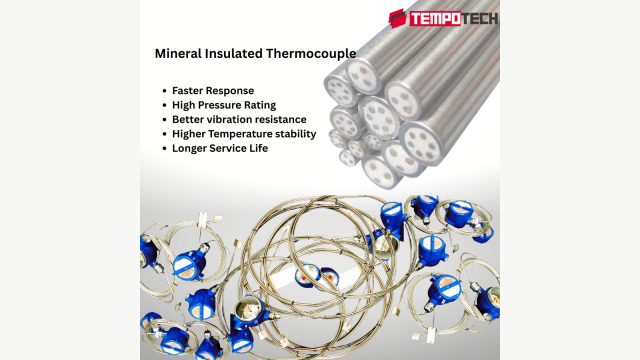
Moisture Resistant –
MgO-packed thermocouples are dried in an oven before sealing both ends. One end of the thermocouple (hot end) is closed with an end cap welded to the sheath, while the other end, usually called the cold end or termination end, is sealed with epoxy.
At TempoTech, we ensure that all MgO-packed thermocouples meet or exceed the electrical insulation requirements of ASTM E220. This is achieved by thoroughly drying the thermocouples in a high-temperature oven before sealing.
MgO-packed thermocouples are impervious to vapors, most liquids, and gases when constructed according to ASTM standards. This protects the thermoelements from corrosion and moisture. In contrast, ceramic beaded thermocouples without protection tubes are more susceptible to oxidation and premature failure.
Vacuum and High-Pressure Rating –
MgO-packed thermocouples are well-suited for vacuum and high-pressure applications. The densely packed MgO insulation inside the metal sheath allows these thermocouples to withstand external pressures of up to 60,000 psi, depending on the selected diameter and construction.
Geometrical Flexibility for Installation –
One of the key advantages of MgO-packed thermocouples is their flexibility in diameter and their ability to be formed into almost any shape to fit the application. MgO thermocouples are available in sizes as small as 0.5 mm (0.020″) OD and as large as ¾” diameter.
With densely packed MgO powder inside the metal sheath, these thermocouples can be bent into the required shape and angle. The MgO insulation maintains uniform spacing between the thermoelement wires and the sheath. MgO-packed thermocouples can typically be bent to a radius of three times the sheath diameter