

When it comes to industrial temperature measurement, the debate of RTD vs thermocouple is one of the most common decisions engineers and technicians face. Both sensor types have earned their place in Canadian industry, but choosing the wrong one can lead to inaccurate readings, premature sensor failure, or unnecessary expense. This guide strips away the marketing noise and gives you a practical, side-by-side comparison focused on accuracy, temperature range, response time, cost, and durability. Whether you are specifying sensors for a food processing line in Ontario, a gas plant in Alberta, or a building automation system in British Columbia, you will find the information you need to make a confident choice.
Table of Contents
- What Are RTD and Thermocouple Sensors?
- RTD vs Thermocouple: Head-to-Head Comparison Table
- Detailed Comparison: Performance Factors
- When to Choose an RTD vs a Thermocouple: Application Guide
- Wiring and Installation Considerations
- Frequently Asked Questions
- Still Unsure? Get Expert Advice from Tempotech
What Are RTD and Thermocouple Sensors?
An RTD, or Resistance Temperature Detector, works on a straightforward principle: the electrical resistance of a pure metal changes predictably as its temperature changes. Most RTDs use platinum because of its excellent linearity and stability. The PT100, which reads 100 ohms at 0°C, is the industry standard across Canada and globally. Other common base metals include nickel and copper, though platinum dominates precision applications.
A thermocouple operates on the Seebeck effect. When two dissimilar metals are joined at a hot junction and the other ends are kept at a known reference temperature, a small millivolt voltage is generated. The magnitude of that voltage corresponds directly to the temperature difference between the hot and cold junctions. Common thermocouple types include Type K (Chromel-Alumel), Type J (Iron-Constantan), and Type T (Copper-Constantan), each suited to different temperature ranges and environments.
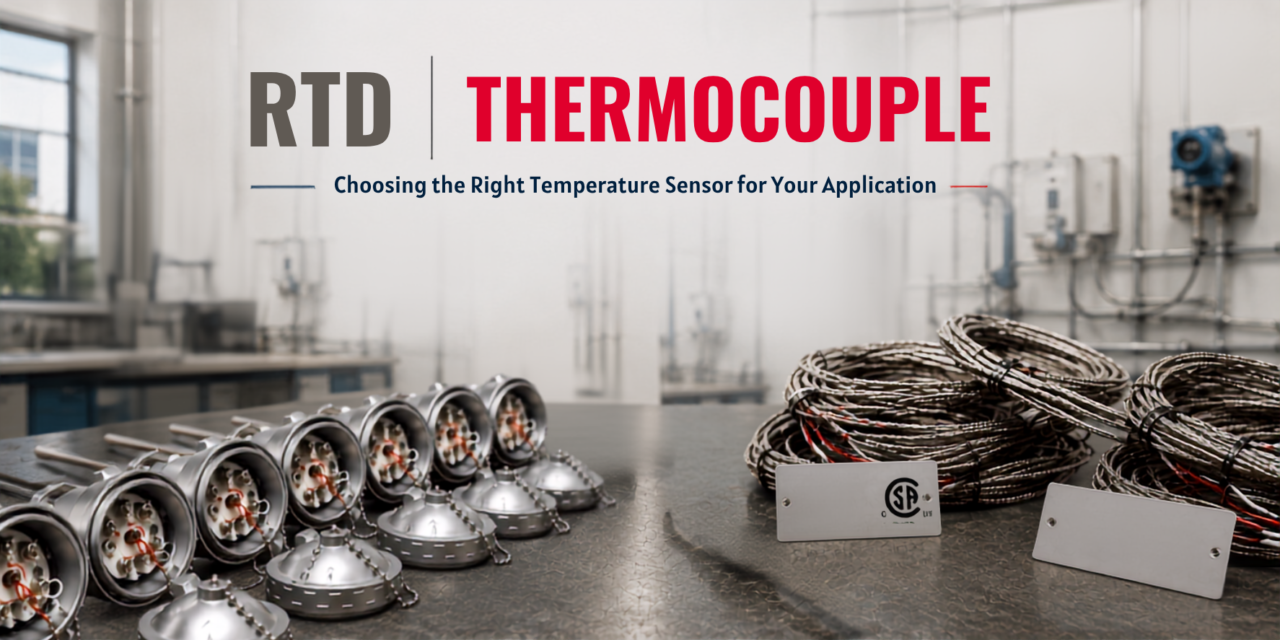
The fundamental distinction between the two sensor types is the output signal. An RTD is a passive sensor that requires an external excitation current to produce a measurable resistance reading. A thermocouple is self-powered, generating its own millivolt signal without any external power source. This difference has downstream implications for wiring, signal conditioning, and system cost.
Both sensor technologies are widely deployed across Canadian industries. Oil and gas operations in Alberta rely heavily on thermocouples for high-temperature processes. Food processors in Ontario and Quebec depend on RTDs for pasteurization and cold chain compliance. HVAC contractors from Vancouver to Halifax use both types depending on whether they are measuring chilled water loops or boiler flue gas. The right choice always comes back to the specific application conditions, including Canada’s cold winter environments and the corrosive atmospheres found in certain industrial settings.
RTD vs Thermocouple: Head-to-Head Comparison Table
The table below provides a quick-reference comparison of the two sensor types across the factors that matter most in industrial and commercial applications.
FeatureRTDThermocoupleTemperature Range-200°C to 660°C (some models to 850°C)-270°C to 2,300°C (Type C to 2,320°C)Accuracy (Typical)±0.1°C to ±0.5°C±1.0°C to ±2.0°C or 0.75% of readingResponse TimeSlower; limited by probe mass and sheathFaster; especially with grounded junctionLong-Term StabilityExcellent; low drift over yearsModerate; prone to drift from oxidation and contaminationDurabilityFragile; sensitive to shock and vibrationRugged; resists vibration, pressure, corrosive environmentsInitial CostHigher; 2–5x more than equivalent thermocoupleLower; economical for basic configurationsOutput SignalResistance (ohms); nearly linearMillivolt; nonlinear, requires linearizationWiring Complexity2-wire, 3-wire, or 4-wire configurationsSimple extension wire (must match thermocouple type)Excitation RequiredYes; external current source neededNo; self-powered
This table highlights the core trade-off: RTDs deliver superior accuracy and stability at moderate temperatures, while thermocouples offer wider range and greater toughness at a lower price point. Neither sensor is universally better. The application dictates the selection.
Detailed Comparison: Performance Factors
Accuracy and Stability
RTDs are the clear winner when measurement precision matters. Typical RTD accuracy ranges from ±0.1°C to ±0.5°C, with laboratory-grade units achieving as tight as ±0.012°C. Thermocouples, by comparison, deliver accuracy in the ±1.0°C to ±2.0°C range or 0.75% of the reading, whichever is greater. That means an RTD can be up to ten times more accurate than a standard thermocouple.
Long-term stability follows the same pattern. RTDs exhibit minimal drift over years of continuous use because platinum is chemically inert and resists degradation at moderate temperatures. Thermocouples, however, are susceptible to metallurgical changes at their hot junction. Oxidation, contamination, and repeated thermal cycling gradually alter the thermoelectric properties of the wire, causing the sensor to drift out of calibration. In critical Canadian applications such as pharmaceutical manufacturing or food safety monitoring under CFIA compliance, RTDs are often preferred specifically for their repeatability and low drift characteristics.
Temperature Range
Thermocouples dominate when temperatures climb. A standard RTD covers -200°C to 660°C, with some specialized thin-film or wire-wound designs reaching 850°C or even 1,000°C in limited cases. Thermocouples, by contrast, stretch from cryogenic lows of -270°C all the way to 2,300°C for noble metal types like Type B, R, and S. Type C thermocouples can handle up to 2,320°C in vacuum or inert atmospheres.
The practical rule of thumb is simple: if your process runs above 660°C, a thermocouple is the only realistic choice. For low-temperature monitoring, the decision is less clear-cut. Canadian cold storage facilities, cryogenic transport operations, and winter-exposed outdoor instrumentation can use either Type T thermocouples or specialized RTDs with good results. The selection hinges more on accuracy requirements and budget than on the low-end range alone.
Response Time
Thermocouples generally respond faster to temperature changes than RTDs. The reason is physical: a thermocouple junction can be made extremely small, even down to exposed wire tips with negligible thermal mass. Grounded junction designs, where the thermocouple wires are welded directly to the inside of the sheath tip, provide the fastest response. RTDs, particularly PT100 elements housed in stainless steel sheaths, have more mass to heat or cool before the sensing element registers the change.
The trade-off is speed versus accuracy. If your application involves rapid temperature fluctuations that must be captured in near real-time, such as engine exhaust monitoring or turbine discharge, a thermocouple is the better fit. If you are measuring a steady-state process where precise control matters more than split-second response, an RTD will serve you better.
Durability and Cost
Thermocouples are built for harsh environments. Their simple construction, two wires joined at a junction, withstands vibration, mechanical shock, high pressure, and corrosive atmospheres far better than the fine platinum coil inside an RTD. In heavy industrial settings like foundries, petrochemical plants, and power generation, thermocouples survive conditions that would destroy an RTD in hours.
Cost follows durability in the opposite direction. An RTD typically costs two to five times more than a thermocouple of equivalent sheath material and connection style. However, the initial purchase price is not the whole story. RTDs require transmitters or specialized PLC input modules with current excitation, adding to the upfront system cost. Thermocouples need cold-junction compensation built into the receiving instrument, but their extension wire is generally less expensive than RTD cable.
Lifecycle cost can tilt in favour of RTDs in clean, moderate-temperature applications. Their superior stability means less frequent calibration and fewer sensor replacements over time. For a pharmaceutical plant or food processing line where downtime is expensive and accuracy is non-negotiable, the higher initial cost of an RTD often pays for itself through reduced maintenance.
When to Choose an RTD vs a Thermocouple: Application Guide
Choose an RTD when your application demands high accuracy at moderate temperatures. If you need ±0.1°C or better, if your process stays below 600°C, and if long-term stability without frequent recalibration is important, an RTD is the right call. Typical applications include laboratory instrumentation, quality control test stands, HVAC chilled water and hot water loop balancing, and clean-in-place systems in food and beverage plants.
Choose a thermocouple when temperatures exceed 660°C, when the sensor will face vibration or corrosive chemicals, or when fast response to rapid temperature swings is essential. Thermocouples are the standard choice for furnaces, kilns, flare stacks, exhaust gas monitoring, and any application where budget constraints intersect with extreme range requirements.
Canadian industry examples illustrate the split clearly. In Alberta’s oil and gas sector, thermocouples handle flare stack monitoring and high-temperature process heaters where RTDs cannot survive. Ontario and Quebec food processors rely on RTDs for pasteurization tunnels, cold chain data logging, and CFIA-mandated temperature verification. Across the country, HVAC building management systems favour RTDs for their accuracy in comfort control applications, while boiler service technicians reach for thermocouples to measure flue gas temperatures that routinely exceed 300°C.
Wiring and Installation Considerations
RTD wiring configurations directly affect measurement accuracy. A 2-wire RTD is the simplest and least expensive option, but the lead wire resistance adds directly to the sensor reading, introducing error. A 3-wire RTD compensates for lead resistance and is the most common choice for Canadian industrial installations, offering a good balance of accuracy and wiring cost. A 4-wire RTD eliminates lead resistance effects entirely and is used in laboratory and high-precision applications. For most field installations in Canada, the 3-wire configuration is the recommended standard.
Thermocouple wiring requires careful attention to material compatibility. Thermocouple extension wire must match the thermocouple type, using the same metal pair as the sensor itself. Substituting standard copper wire creates unintended junctions that corrupt the measurement. In Canada, thermocouple wire colour coding follows CSA standards, which differ from both the ANSI codes used in the United States and the IEC codes used internationally. Always verify that your installation uses CSA-compliant colour coding to avoid wiring errors during commissioning and maintenance.
Signal conditioning differs between the two sensor types. An RTD requires a transmitter or a PLC analog input module that supplies a stable excitation current and reads the resulting voltage drop across the sensor. Many modern temperature controllers and PLCs include built-in RTD input channels. Thermocouples require cold-junction compensation, or CJC, which is typically built into the measuring instrument. The CJC circuit measures the temperature at the connection terminals and mathematically compensates for the reference junction.
In electrically noisy environments, such as manufacturing plants with variable frequency drives, both sensor types benefit from shielded cable. Route signal wiring away from power cables, use twisted-pair conductors, and ground the shield at one end only to prevent ground loops. These practices apply equally to RTD and thermocouple installations across Canadian industrial sites.
Frequently Asked Questions
Which is more accurate, an RTD or a thermocouple?
RTDs are significantly more accurate. Standard industrial RTDs achieve ±0.1°C to ±0.5°C, while thermocouples typically deliver ±1.0°C to ±2.0°C. In precision applications, RTDs can be up to ten times more accurate than standard thermocouples.
Can a thermocouple replace an RTD?
Not as a drop-in replacement. A thermocouple can substitute for an RTD only if the application tolerates lower accuracy and the receiving instrument supports thermocouple input with cold-junction compensation. The wiring, signal conditioning, and calibration procedures are all different.
What is the most common RTD type?
The PT100, which measures 100 ohms at 0°C, is the industry standard worldwide and across Canada. PT500 and PT1000 variants are also available for applications requiring higher signal levels or lower current consumption.
What is the most common thermocouple type?
Type K (Chromel-Alumel) is the most widely used general-purpose thermocouple, covering -270°C to 1,260°C. Type J (Iron-Constantan) is common for lower-temperature applications up to 760°C, though its iron leg makes it vulnerable to corrosion in humid environments.
Do I need a transmitter for an RTD?
Yes. RTDs are passive sensors that require an excitation current to produce a measurable signal. Many PLCs, temperature controllers, and data acquisition systems include built-in RTD input channels, eliminating the need for a separate transmitter in many cases.
How do I know if my sensor is failing?
RTDs most commonly fail open, showing infinite resistance on a multimeter. Thermocouples tend to drift gradually, producing readings that shift away from known reference values. They can also fail open or develop erratic readings from intermittent connections. Regular calibration against a known standard is the best way to catch degradation before it affects your process.
Still Unsure? Get Expert Advice from Tempotech
Choosing between an RTD and a thermocouple does not have to be a solo effort. The team at Tempotech brings decades of experience specifying temperature sensors for Canadian industries, from oil and gas and food processing to HVAC and manufacturing. We can help you evaluate your application requirements, weigh the trade-offs between accuracy and durability, and select a sensor that fits both your process needs and your budget.
Whether you need a high-accuracy RTD for a clean pharmaceutical environment or a rugged thermocouple for a furnace application, we offer custom probe design, product recommendations, and free consultation to get you the right solution. Our team understands the unique demands of Canadian industrial environments, including CSA wiring standards, cold-weather performance, and corrosive process conditions.
Contact us today to discuss your temperature measurement challenge. Our Canadian support team is ready to help you make the right choice.