Copper Tip Bearing RTD vs. Isolated Tip Bearing RTD: Which Is Best for Motor Monitoring?
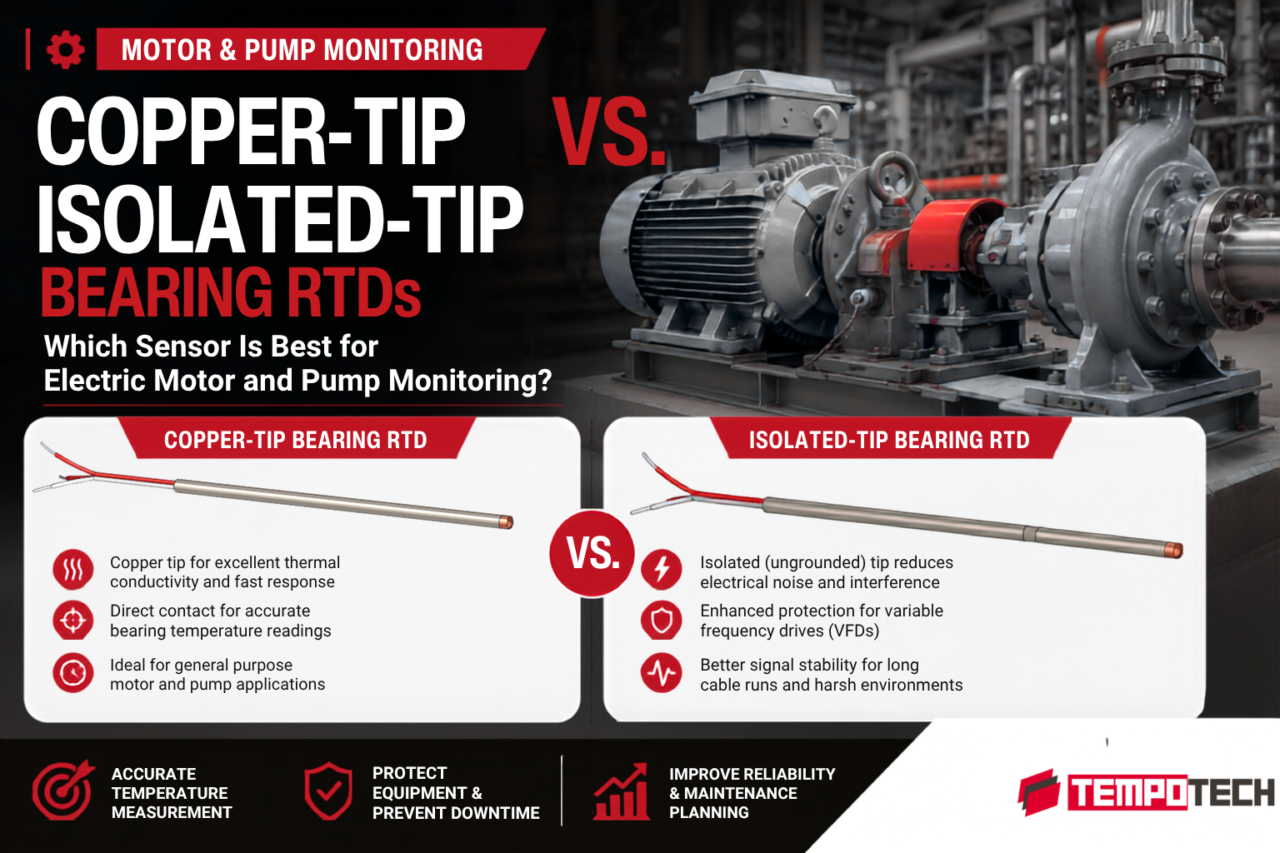
Copper-Tip Bearing RTD vs. Isolated-Tip Bearing RTD comparison for electric motor and pump monitoring, highlighting response time, electrical isolation, VFD compatibility, and predictive maintenance applications.
In modern motor monitoring, bearing temperature sensing is a critical input for predictive maintenance programs. Two prominent RTD configurations—copper tip bearing RTDs and isolated tip bearing RTDs—offer different advantages and trade-offs. This article dives into how each sensor type integrates with real-world motor systems, how installation and environment influence performance, and what manufacturers should consider when designing a monitoring strategy.We’ll explore not just the sensor tip design, but how that tip design translates into data quality, maintenance costs, and reliability under challenging operating conditions. By the end, you’ll be equipped to map sensor selection to motor type, bearing regime, and maintenance objectives.
Copper tip RTDs provide direct contact with the bearing surface. This arrangement can deliver rapid thermal response and potentially high sensitivity to bearing temperature changes. However, the copper tip presents a direct electrical path that can be more susceptible to ground loops and EMI in certain motor environments. Isolated tip RTDs introduce electrical isolation at the contact point, helping to mitigate electrical noise and ground loop issues that can otherwise contaminate temperature readings in electrically noisy machinery.
When selecting between these configurations, engineers weigh factors such as thermal contact quality, installation complexity, and how signal integrity will be maintained through environmental disturbances like vibration, moisture, or conductive lubricants. Below, we break down the core performance considerations that influence data reliability and maintenance planning.
The recurring question is whether the marginal gains in response time or accuracy from a copper tip translate into meaningful maintenance benefits, given the added considerations for electrical isolation and wiring integrity. The next sections probe these aspects through practical lenses: installation, reliability, and real-world outcomes.
Installation Considerations: Practicality and Reliability
Installation complexity can be a deciding factor, especially in retrofit projects or tight motor housings. Copper tip RTDs favor direct contact to the bearing surface, which can simplify the sensing assembly but may require careful machining or alignment for consistent contact. Isolated tip RTDs, by contrast, emphasize electrical isolation at the contact point, which can mean additional shielding, isolation grommets, or specialized connectors to maintain signal integrity in noisy environments.
Mounting methods: direct copper contact versus insulated contact. Direct contact may yield faster response but demands clean, stable contact surfaces.
Cable routing, connector types, and sealing in harsh environments to prevent moisture ingress and vibration damage.
Maintenance implications: sensor replacement, calibration routines, and accessibility for routine inspections.
Compatibility with motor housings, bearing footprints, and lubrication regimes that influence heat transfer to the sensor.
Reliability and Maintenance: Predictive Insights for Reliability Programs
Bearings generate heat as they operate, and sensing this temperature effectively enables predictive maintenance. Copper tip RTDs, with direct bearing contact, can capture rapid temperature excursions but may be more sensitive to contact degradation over time. Isolated tip RTDs reduce electrical noise susceptibility and can deliver more stable readings in EMI-rich environments, which can reduce false alarms and improve long-term drift behavior.
Key reliability considerations include:
Long-term drift and calibration intervals for each RTD type.
Failure modes: what can go wrong with copper tip versus isolated tip sensors in motors of different sizes and lubrication regimes.
Cost considerations: sensor lifespan, maintenance downtime, and total cost of ownership when factoring installation effort and signal conditioning needs.
Case Study Snapshot: Real-World Impacts in Motor Monitoring
While this article presents synthetic, anonymized scenarios to illustrate concepts, consider the following combined insights drawn from practical deployments:
In a hypothetical but representative setup, copper tip RTDs detected a gradual bearing temperature increase that preceded a fault by several weeks. This allowed maintenance to schedule a controlled intervention before an unplanned outage. A parallel deployment using isolated tip RTDs in a comparable motor class showed fewer nuisance alarms and more stable long-term readings in an EMI-prone environment, underscoring the value of electrical isolation for systems with high electrical noise. The takeaway is that motor size, environment, and monitoring goals should guide sensor selection, not a one-size-fits-all policy.
Best Practices: Selecting the Right RTD for Your Motor Monitoring Program
To maximize reliability and data quality, follow these guidelines when choosing an RTD configuration:
Consider environment and EMI; in electrically noisy facilities, isolation can reduce spurious readings.
Plan integration with existing monitoring systems and analytics workflows to ensure data is actionable.
Establish data retention, alarm criteria, and maintenance schedules tied to bearing life cycles and production requirements.
Conclusion: Aligning RTD Choice with Monitoring Goals
Copper tip RTDs excel when rapid thermal response and intimate bearing contact translate into timely maintenance decisions and where electrical noise is manageable through proper grounding and shielding. Isolated tip RTDs shine in EMI-prone environments, offering robust signal integrity and more predictable long-term performance. The optimal choice is rarely absolute; it is the result of aligning motor size, bearing regime, lubrication practices, and the broader monitoring architecture with a clearly defined reliability objective.
For most motor monitoring programs, a hybrid or site-specific approach can be effective: use copper tip RTDs in clean electrical environments with accessible bearing housings, and deploy isolated tip RTDs in facilities with significant electrical interference or when suppression of ground loops is a priority. The goal is to build a data-driven maintenance plan that minimizes downtime while maximizing visibility into bearing health.
Key Takeaways
Copper tip RTDs provide fast thermal response and direct contact, but may require careful grounding strategies in EMI-heavy environments.
Isolated tip RTDs improve signal integrity and reduce ground-loop risk, with generally robust performance in challenging electrical conditions.
Installation decisions should consider bearing accessibility, lubrication regime, and housing design to ensure reliable contact and wiring.
Related Reading
To deepen your understanding of bearing temperature monitoring, you may find these related posts helpful: